



- README-JA(日本語)
- What is Sisimai
- Setting Up Sisimai
- Usage
- Sisimai Specification
- Contributing
- Other Information
- Author
- Copyright
- License
What is Sisimai
Sisimai is a Perl module for analyzing RFC5322 bounce emails and generating structured data from parsed results. Sisimai is the system formerly known as bounceHammer 4, is the successor to bounceHammer.
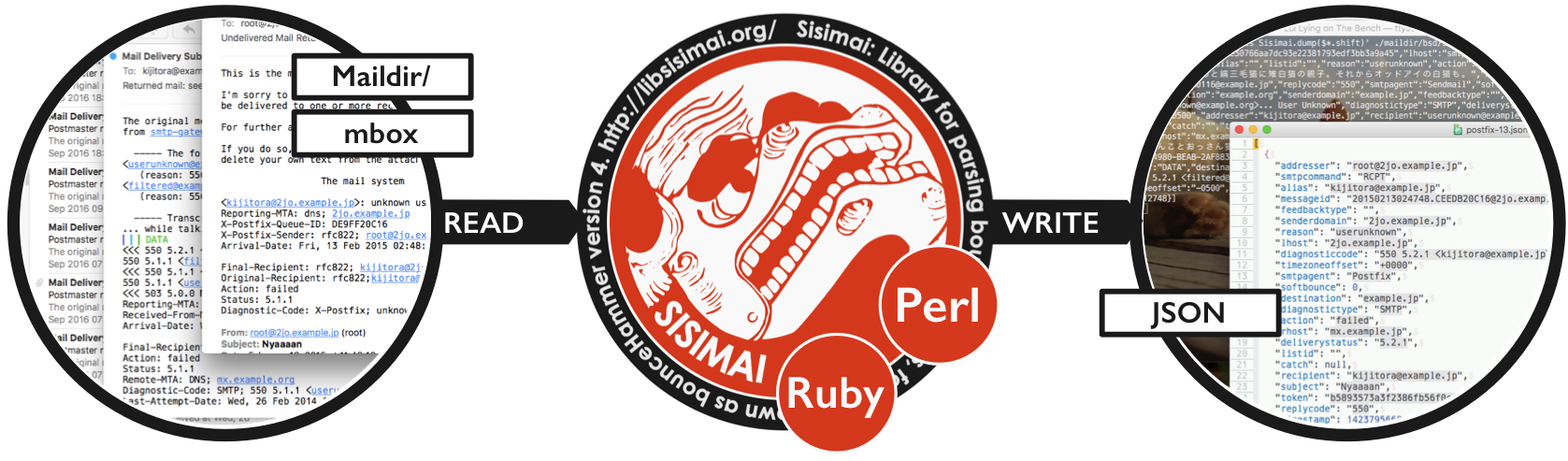
Key features
- Convert Bounce Mails to Structured Data
- Supported formats are Perl(Hash, Array) and JSON(String)
- Easy to Install, Use.
cpan,cpanm, orcpm- git clone & make
- High Precision of Analysis
- 2 times higher than bounceHammer
- Support 68 MTAs/MDAs/ESPs
- Support Feedback Loop Message(ARF)
- Can detect 32 error reasons
- Faster than bounceHammer 2.7.13p3
- About 2.0 times faster
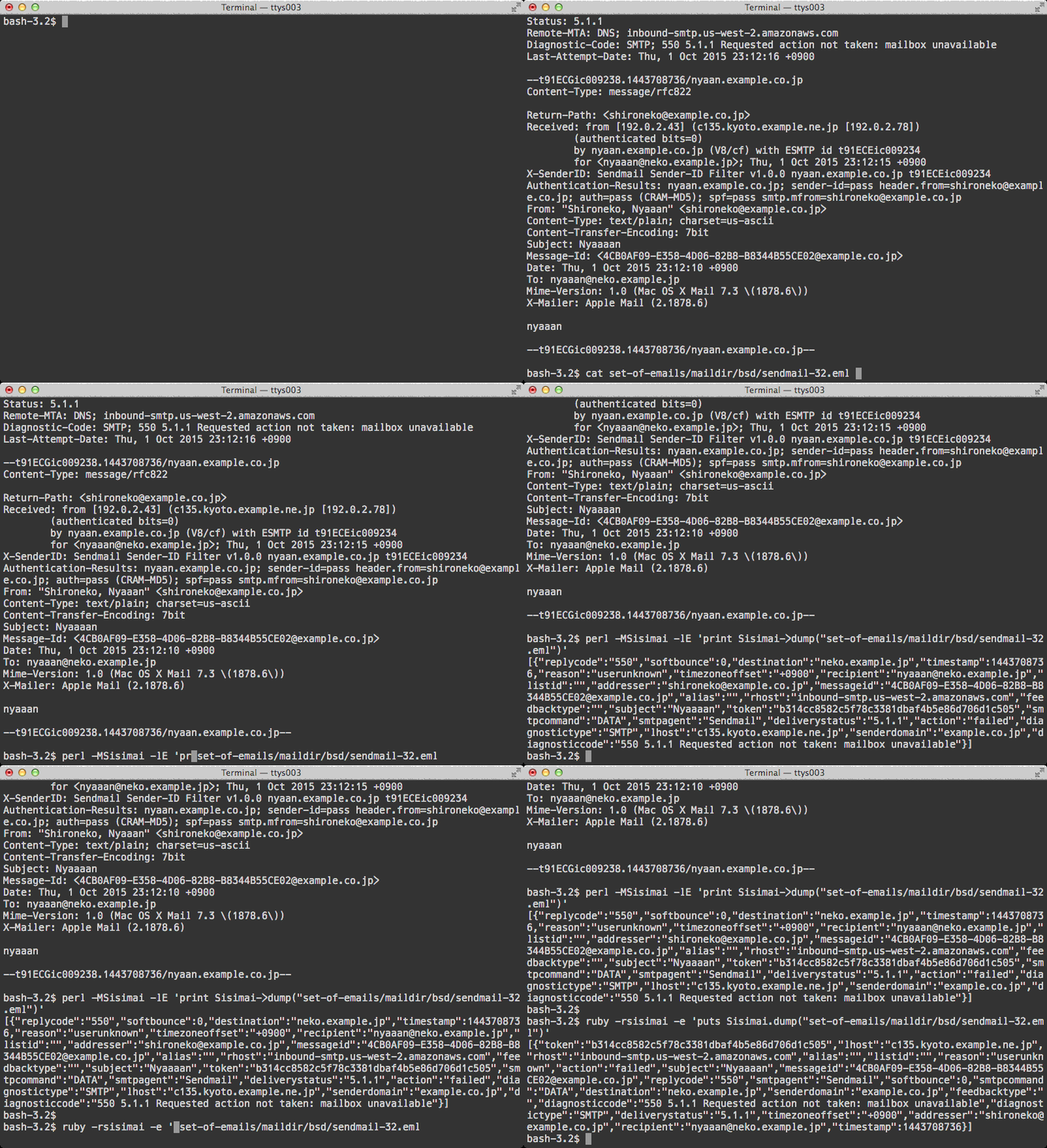
Command line demo
The following screen shows a demonstration of Sisimai at the command line using Perl(p5-sisimai) and
Ruby(rb-sisimai) version of Sisimai.
Setting Up Sisimai
System requirements
More details about system requirements are available at Sisimai | Getting Started page.
Install
From CPAN
$ cpanm --sudo Sisimai
--> Working on Sisimai
Fetching http://www.cpan.org/authors/id/A/AK/AKXLIX/Sisimai-4.25.5.tar.gz ... OK
...
1 distribution installed
$ perldoc -l Sisimai
/usr/local/lib/perl5/site_perl/5.30.0/Sisimai.pm
From GitHub
$ cd /usr/local/src
$ git clone https://github.com/sisimai/p5-sisimai.git
$ cd ./p5-sisimai
$ make install-from-local
--> Working on .
Configuring Sisimai-4.25.5 ... OK
1 distribution installed
Usage
Basic usage
Sisimai->rise() method provides feature for getting parsed data as Perl Hash reference from bounced
email messages like following. Beginning with v4.25.6, new accessor origin which keeps the path to
email file as a data source is available.
#! /usr/bin/env perl
use Sisimai;
my $v = Sisimai->rise('/path/to/mbox'); # or path to Maildir/

# Beginning with v4.23.0, both rise() and dump() method of Sisimai class can read bounce messages
# from variable instead of a path to mailbox
use IO::File;
my $r = '';
my $f = IO::File->new('/path/to/mbox'); # or path to Maildir/
{ local $/ = undef; $r = <$f>; $f->close }
my $v = Sisimai->rise(\$r);

# If you want to get bounce records which reason is "delivered", set "delivered" option to rise()
# method like the following:
my $v = Sisimai->rise('/path/to/mbox', 'delivered' => 1);

# Beginning with v5.0.0, sisimai does not return the reulst which "reason" is "vaction" by default.
# If you want to get bounce records which reason is "vacation", set "vacation" option to rise()
# method like the following:
my $v = Sisimai->rise('/path/to/mbox', 'vacation' => 1);

if( defined $v ) {
    for my $e ( @$v ) {
        print ref $e;                   # Sisimai::Data
        print ref $e->recipient;        # Sisimai::Address
        print ref $e->timestamp;        # Sisimai::Time

        print $e->addresser->address;   # shironeko@example.org # From
        print $e->recipient->address;   # kijitora@example.jp   # To
        print $e->recipient->host;      # example.jp
        print $e->deliverystatus;       # 5.1.1
        print $e->replycode;            # 550
        print $e->reason;               # userunknown
        print $e->origin;               # /var/spool/bounce/new/1740074341.eml
        print $e->hardbounce;           # 1

        my $h = $e->damn();             # Convert to HASH reference
        my $j = $e->dump('json');       # Convert to JSON string
        print $e->dump('json');         # JSON formatted bounce data
    }
}
Convert to JSON
Sisimai->dump() method provides feature for getting parsed data as JSON string from bounced email
messages like the following code:
#! /usr/bin/env perl
use Sisimai;

# Get JSON string from parsed mailbox or Maildir/
my $j = Sisimai->dump('/path/to/mbox'); # or path to Maildir/
                                        # dump() is added in v4.1.27
print $j;                               # parsed data as JSON

# dump() method also accepts "delivered" option like the following code:
my $j = Sisimai->dump('/path/to/mbox', 'delivered' => 1);
Callback feature
c___ argument of Sisimai->rise and Sisimai->dump is an array reference and is a parameter to
receive code references for callback feature. The first element of c___ argument is called at
Sisimai::Message->parse for dealing email headers and entire message body. The second element of
c___ argument is called at the end of each email file parsing. The result generated by the callback
method is accessible via Sisimai::Data->catch.
[0] For email headers and the body
Callback method set in the first element of c___ is called at Sisimai::Message->parse().
#! /usr/bin/env perl
use Sisimai;
my $code = sub {
    my $args = shift;               # (*Hash)
    my $head = $args->{'headers'};  # (*Hash)  Email headers
    my $body = $args->{'message'};  # (String) Message body
    my $adds = { 'x-mailer' => '', 'queue-id' => '' };

    if( $body =~ m/^X-Postfix-Queue-ID:\s*(.+)$/m ) {
        $adds->{'queue-id'} = $1;
    }

    $adds->{'x-mailer'} = $head->{'x-mailer'} || '';
    return $adds;
};
my $data = Sisimai->rise('/path/to/mbox', 'c___' => [$code, undef]);
my $json = Sisimai->dump('/path/to/mbox', 'c___' => [$code, undef]);

print $data->[0]->catch->{'x-mailer'};    # "Apple Mail (2.1283)"
print $data->[0]->catch->{'queue-id'};    # "43f4KX6WR7z1xcMG"
[1] For each email file
Callback method set in the second element of c___ is called at Sisimai->rise() method for
dealing each email file.
my $path = '/path/to/maildir';
my $code = sub {
    my $args = shift;           # (*Hash)
    my $kind = $args->{'kind'}; # (String)  Sisimai::Mail->kind
    my $mail = $args->{'mail'}; # (*String) Entire email message
    my $path = $args->{'path'}; # (String)  Sisimai::Mail->path
    my $sisi = $args->{'sisi'}; # (*Array)  List of Sisimai::Data

    for my $e ( @$sisi ) {
        # Insert custom fields into the parsed results
        $e->{'catch'} ||= {};
        $e->{'catch'}->{'size'} = length $$mail;
        $e->{'catch'}->{'kind'} = ucfirst $kind;

        if( $$mail =~ /^Return-Path: (.+)$/m ) {
            # Return-Path: <MAILER-DAEMON>
            $e->{'catch'}->{'return-path'} = $1;
        }

        # Append X-Sisimai-Parsed: header and save into other path
        my $a = sprintf("X-Sisimai-Parsed: %d\n", scalar @$sisi);
        my $p = sprintf("/path/to/another/directory/sisimai-%s.eml", $e->token);
        my $f = IO::File->new($p, 'w');
        my $v = $$mail; $v =~ s/^(From:.+)$/$a$1/m;
        print $f $v; $f->close;
    }

    # Remove the email file in Maildir/ after parsed
    unlink $path if $kind eq 'maildir';

    # Need to not return a value
};

my $list = Sisimai->rise($path, 'c___' => [undef, $code]);
print $list->[0]->{'catch'}->{'size'};          # 2202
print $list->[0]->{'catch'}->{'kind'};          # "Maildir"
print $list->[0]->{'catch'}->{'return-path'};   # "<MAILER-DAEMON>"
More information about the callback feature is available at Sisimai | How To Parse - Callback Page.
One-Liner
Beginning with Sisimai 4.1.27, Sisimai->dump() method is available and you can get parsed data as
JSON using the method.
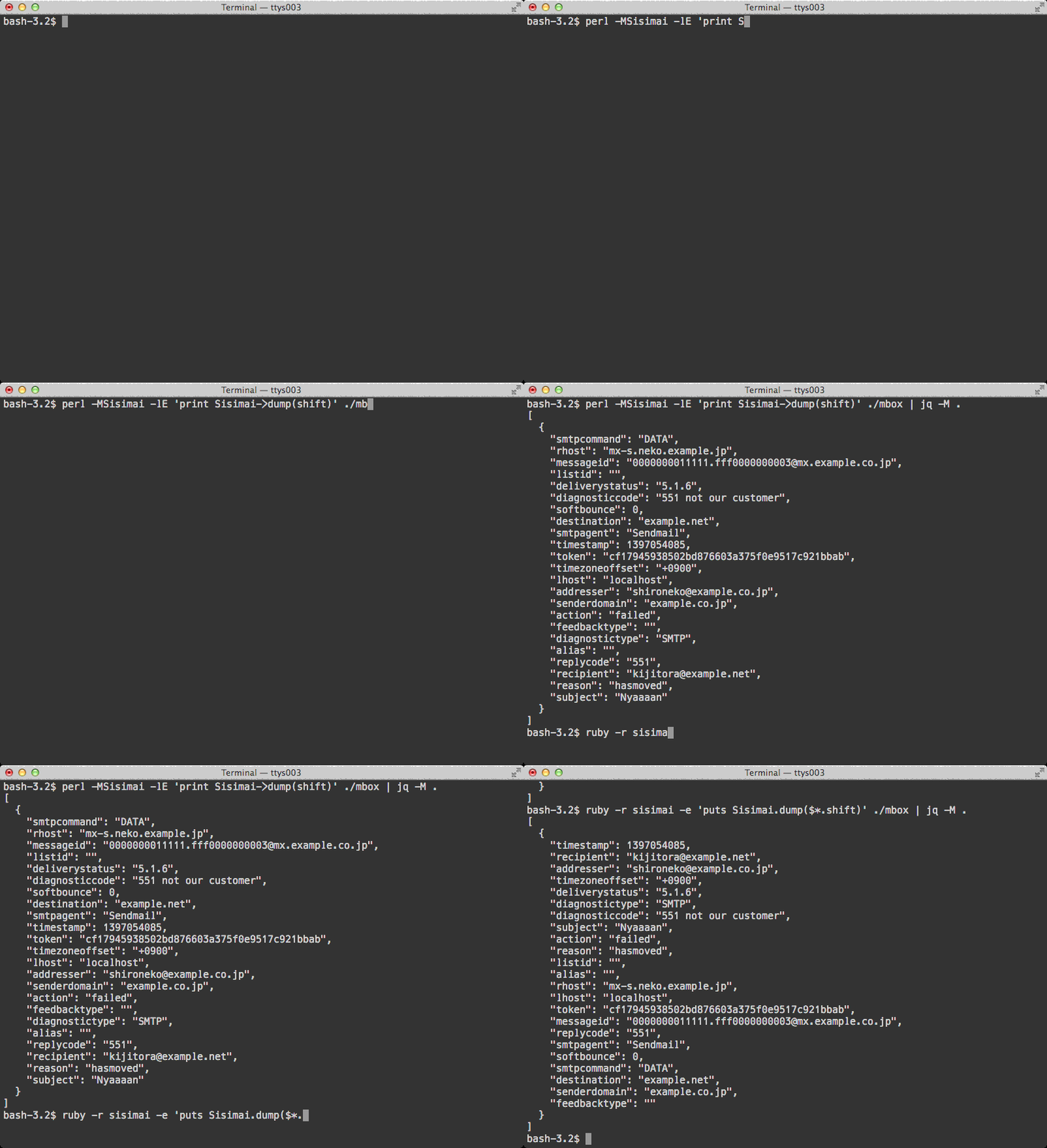
$ perl -MSisimai -lE 'print Sisimai->dump(shift)' /path/to/mbox
Output example
[{"smtpagent": "Sendmail","reason": "hasmoved","recipient": "kijitora@example.net","replycode": "","senderdomain": "example.co.jp","alias": "","timezoneoffset": "+0900","deliverystatus": "5.1.6","timestamp": 1397086485,"origin": "set-of-emails/maildir/bsd/lhost-sendmail-22.eml","catch": {"x-mailer": "","queue-id": "","sender": ""},"destination": "example.net","subject": "Nyaaaan","lhost": "localhost","rhost": "mx-s.neko.example.jp","listid": "","messageid": "0000000011111.fff0000000003@mx.example.co.jp","addresser": "shironeko@example.co.jp","action": "failed","diagnostictype": "SMTP","smtpcommand": "DATA","feedbacktype": "","token": "61b5ea94209460ac018c1a2060bdab0acce9ffed","hardbounce": 1,"diagnosticcode": "450 busy - please try later 551 not our customer 503 need RCPT command [data]"}]
Sisimai Specification
Differences between bounceHammer and Sisimai
The following table show the differences between bounceHammer 2.7.13p3 and Sisimai. More information about differences are available at Sisimai | Differences page.
| Features | bounceHammer | Sisimai | |------------------------------------------------|---------------|-------------| | System requirements(Perl) | 5.10 - 5.14 | 5.10 - 5.30 | | Command line tools | Available | N/A | | Modules for Commercial MTAs and MPSs | N/A | Included | | WebUI/API | Included | N/A | | Database schema for storing parsed bounce data | Available | N/A[1] | | Analytical precision ratio(2000 emails)[2] | 0.61 | 1.00 | | The speed of parsing email(1000 emails) | 4.24s | 1.35s[3] | | The number of detectable bounce reasons | 19 | 29 | | The number of MTA modules(parser engine) | 15 | 68 | | Parse 2 or more bounces in a single email | Only 1st rcpt | ALL | | Parse FeedBack Loop Message/ARF format mail | Unable | OK | | Classification based on recipient domain | Available | N/A | | Output format of parsed data | YAML,JSON,CSV | JSON only | | Easy to install | No | Yes | | Install using cpan, cpanm, or cpm command | N/A | OK | | Dependencies (Except core modules of Perl) | 24 modules | 2 modules | | LOC:Source lines of code | 18200 lines | 10500 lines | | The number of tests in t/, xt/ directory | 27365 tests | 311000 tests| | License | GPLv2 or Perl | 2 clause BSD| | Support Contract provided by Developer | End Of Sales | Available |
- Implement yourself with using DBI or any O/R Mapper you like
- See ./ANALYTICAL-PRECISION
- Xeon E5-2640 2.5GHz x 2 cores | 5000 bogomips | 1GB RAM | Perl 5.24.1
Other specification of Sisimai
Contributing
Bug report
Please use the issue tracker to report any bugs.
Emails could not be parsed
Bounce mails which could not be parsed by Sisimai are saved in the repository set-of-emails/to-be-debugged-because/sisimai-cannot-parse-yet. If you have found any bounce email cannot be parsed using Sisimai, please add the email into the directory and send Pull-Request to this repository.
Other Information
Related sites
- @libsisimai | Sisimai on Twitter (@libsisimai)
- libSISIMAI.ORG | Sisimai | The Successor To bounceHammer, Library to parse bounce mails
- Sisimai Blog | blog.libsisimai.org
- Facebook Page | facebook.com/libsisimai
- GitHub | github.com/sisimai/p5-sisimai
- CPAN | Sisimai - Mail Analyzing Interface for bounce mails. - metacpan.org
- CPAN Testers Reports | CPAN Testers Reports: Reports for Sisimai
- Ruby verson | Ruby version of Sisimai
- Fixtures | set-of-emails - Sample emails for "make test"
- bounceHammer.JP | bounceHammer will be EOL on February 29, 2016
See also
- README-JA.md - README.md in Japanese(日本語)
- RFC3463 - Enhanced Mail System Status Codes
- RFC3464 - An Extensible Message Format for Delivery Status Notifications
- RFC3834 - Recommendations for Automatic Responses to Electronic Mail
- RFC5321 - Simple Mail Transfer Protocol
- RFC5322 - Internet Message Format
Author
Copyright
Copyright (C) 2014-2023 azumakuniyuki, All Rights Reserved.
License
This software is distributed under The BSD 2-Clause License.